
Apr. 21, 2026 — This is not a story of a “horrific murder.” It is not even the story of an “especially vicious” assault. It didn’t happen in the subway; there was no “gunplay” involved.
It’s just what I guess you would call a regular assault on a 75-year-old woman, apparently for having told two people to clean up after their (unleashed) dogs.
Linda Scott, the 75-year-old, owns a home on President Street, just off Troy Avenue in Crown Heights (which is within the bounds of the 71st Precinct). According to the Daily News, Scott has had an ongoing problem with the empty lot next door, where neighbors have perennially allowed their dogs to poop (without cleaning it up). The lot has attracted rats and raccoons as well.
On Monday, Apr. 6, at some point shortly after asking two younger women (one described as a neighbor) to clean up after their dogs, an argument ensued and one of the younger women started punching and kicking Scott. The assault part of the interaction was caught on video. Scott was taken to Interfaith Medical Center and treated there for injuries to her face and shoulder.
News of the attack was also covered by News12 Brooklyn, WPIX, and the New York Post.
On Apr. 10, the Police Department released a photo of the suspect (below). The office of the Deputy Commissioner for Public Information (DCPI) stated in an email on Apr. 17 that no arrest had been made; a DCPI spokesperson confirmed just before publication today that there is no further update on the case.
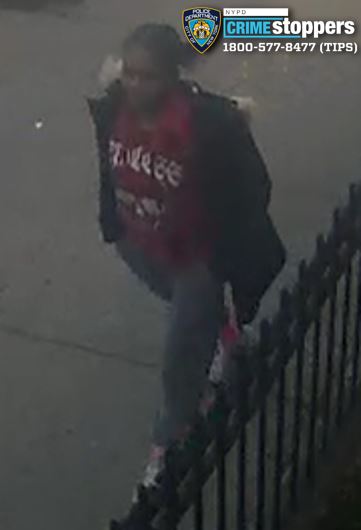
Early yesterday afternoon, I emailed press spokespeople for three local representatives, each of whose districts encompass Scott’s home: City Council Member Crystal Hudson, State Assembly Member Brian Cunningham, and State Senator Zellnor Myrie. I laid my cards on the table: “I’m not planning this as a super complex piece, basically just asking as a lifelong New Yorker (raised deep in Brooklyn), ‘What on earth is going on when asking someone to pick up after her dog triggers a much younger woman to physically attack a 75-year-old?’”
I got no response from any of the three.
My question to the local politicians was genuine: we simply can’t accept violent responses like this (and, to put the most charitable spin on it, the lack of impulse control that allowed rage to be translated into action). We can’t accept it (or excuse it) in any part of our city. The complete story might turn out to be more complicated than it seems now (see sidebar), but, even if it were, being outraged is not a license for assault, morally or legally.
The “in any part of the city” is crucial here. Too many persist in either looking at crime in the city as though it were present in equal measure in all neighborhoods, or else write off some neighborhoods as ones where higher crimes rates should be expected, as though a natural phenomenon.
As it happens, when comparing felony assaults in the last pre-pandemic year (2019) to the most recent full year of data available, the 71st Precinct is quite similar to citywide statistics: felony assaults are 41 percent higher in the precinct; citywide, felony assaults in 2025 were at a level 44 percent higher than 2019. (Full historical precinct-level data from 2000-2025 are here.) In 2026 year-to-date, for both the city and the 71st Precinct, felony assaults are essentially flat comparing the same period in 2025.
Looking at the 2025 data comparatively across precincts, though, the 71st Precinct was in the upper third of felony assault frequency, ranking 22nd out of 78 precincts. Its 437 assaults were far below the four precincts (40th, 44th, 47th, and 75th) that recorded more than 1,000 each, but far above the fewer than 200 felony assaults reported in each of some 19 precincts.
Life (and the level of background fear) is, indeed, very different depending on where in the city you live.
So what should be done here?
Because the attacker did not inflict “serious injury” as defined in the Penal Code, the offense would normally be treated as a misdemeanor (assault in the third degree). Here, however, the victim was at least 65 years old and the attacker was at least 18 years old and at least 10 years younger than the vicim. The combination of these factors, per subdivision 12 of Penal Law § 120.05, makes the offense a violent D felony, punishable by a term in prison that could range anywhere from two to seven years. On the other hand, if the attacker turns out to be someone who has not had a previous felony conviction, and if the court is of the opinion that a longer sentence would be unduly harsh “having regard to the nature and circumstances of the crime and to the history and character of the defendant,” a term of imprisonment of a year or less is permissible.
We don’t yet know the history of the attacker; we don’t yet have the full picture of the entire interaction. But the state legislature, in singling out attacks on older New Yorkers as a felony offense, has already said, in effect, “Don’t do it: we really mean it.” We oughtn’t be squeamish about carrying out that command.
I’ve always thought (and I still think) that the shortest sentence consistent with deterrence and vindicating the public interest is the one that should be imposed. Here — unless something entirely unexpected emerges — that should mean the attacker spends some time incarcerated.