
Overall response by NYC’s Health Dept. has been swift and decisive, and outbreak appears to be waning. More fatalities still possible. Questions remain over adequacy of information provided to public. “Privacy” rationale for non-disclosure shaky.
Jul. 19. 2026 — A little more than two weeks after two cases of Legionnaires’ disease on Manhattan’s Upper East Side led the city’s Department of Health and Mental Hygiene (DOHMH) to launch an investigation of, and remediation campaign in, the entire neighborhood, it appears that the outbreak is waning, as the Department’s Commissioner, Dr. Alister Martin, has told numerous news outlets.
Perhaps most encouragingly, DOHMH announced late on Jul. 14 that all cooling towers in the relevant area had been tested and that all 76 buildings with cooling towers that had tested PCR-positive (that’s the molecular test, which detects the presence of both live and dead Legionnaires’)1 had already fully remediated the cooling tower or had been ordered to fully remediate the cooking tower by Jul. 16.
There has so far been three fatalities. In an outbreak that has thus far seen a total of 72 confirmed cases, it would not surprising to see more (the CDC cites a case-facility rate of approximately 10 percent. Nine patients are currently hospitalized per DOHMH’s latest update.)
The scope of remediation ordered
The remediation that has been directed by DOHMH is an extensive, multi-part process.
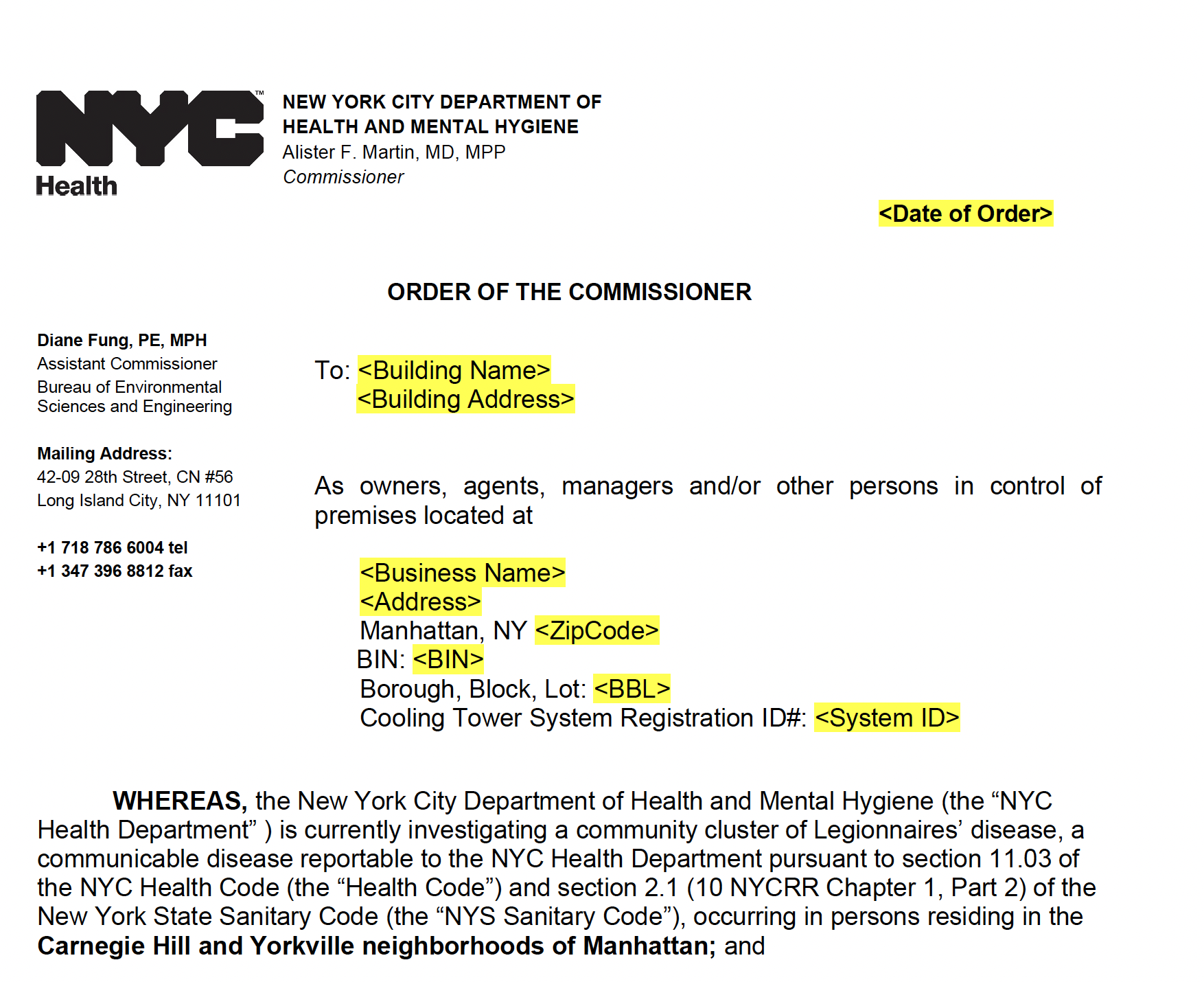
Read the full text of the Health Commissioner’s remediation orders
(Read a copy of a sample of the Commissioner’s Order, at the left.) Each building whose cooling tower was found to have been positive on molecular (PCR) testing for Legionella bacteria is required to apply a biocide, clean and flush the cooling tower, re-test the cooling tower, document all results, and report those results to DOHMH.
I asked Janet E. Stout, a leading expert of Legionnaire’s disease, to review the sample order. She viewed the required timetable as “aggressive” but “understandable given the urgency to halt such a large outbreak.”
Stout noted that, “It will be important for DOHMH to monitor post-treatment results closely because a single treatment, especially if only 5 mg/L of free chlorine [an option available to building owners], may not get Legionella levels down to acceptable levels.”
So many questions; not enough answers
DOHMH spokesperson William Fowler stated unequivocally that DOHMH does not simply rely on a building’s certification that it has remediated, but rather conducts its own follow-up inspection. He did not, however, answer my inquiry as to what that follow-up inspection involves.
I also asked whether any of the people who are confirmed to have Legionnaires’ are people who neither lived in, worked in, nor traveled in the three zip codes (10028, 10128, 10075) where DOHMH is urging vigilance. (The original zone encompassed only 10028 and 10128, but when one or more cases in 10075 emerged, DOHMH expanded) the zone.
There may be a simple answer (“no”), but it hasn’t been provided. It is an important question. Fowler stated that DOHMH typically sees cases within a 1 kilometer radius. That would fit the three-zip-code zone if the point from which the radii were being drawn were precisely in the geographic center of those combined zip-code areas.
But another way to think about it is that Legionnaires’ contaminated droplets can travel a very long way — perhaps 6 kilometers. To be conservative, though, and accounting for an urban environment, what would the area of concern be if one drew only a 1 kilometer radius around each cooling tower that testing PCR-positive? Click on the map.
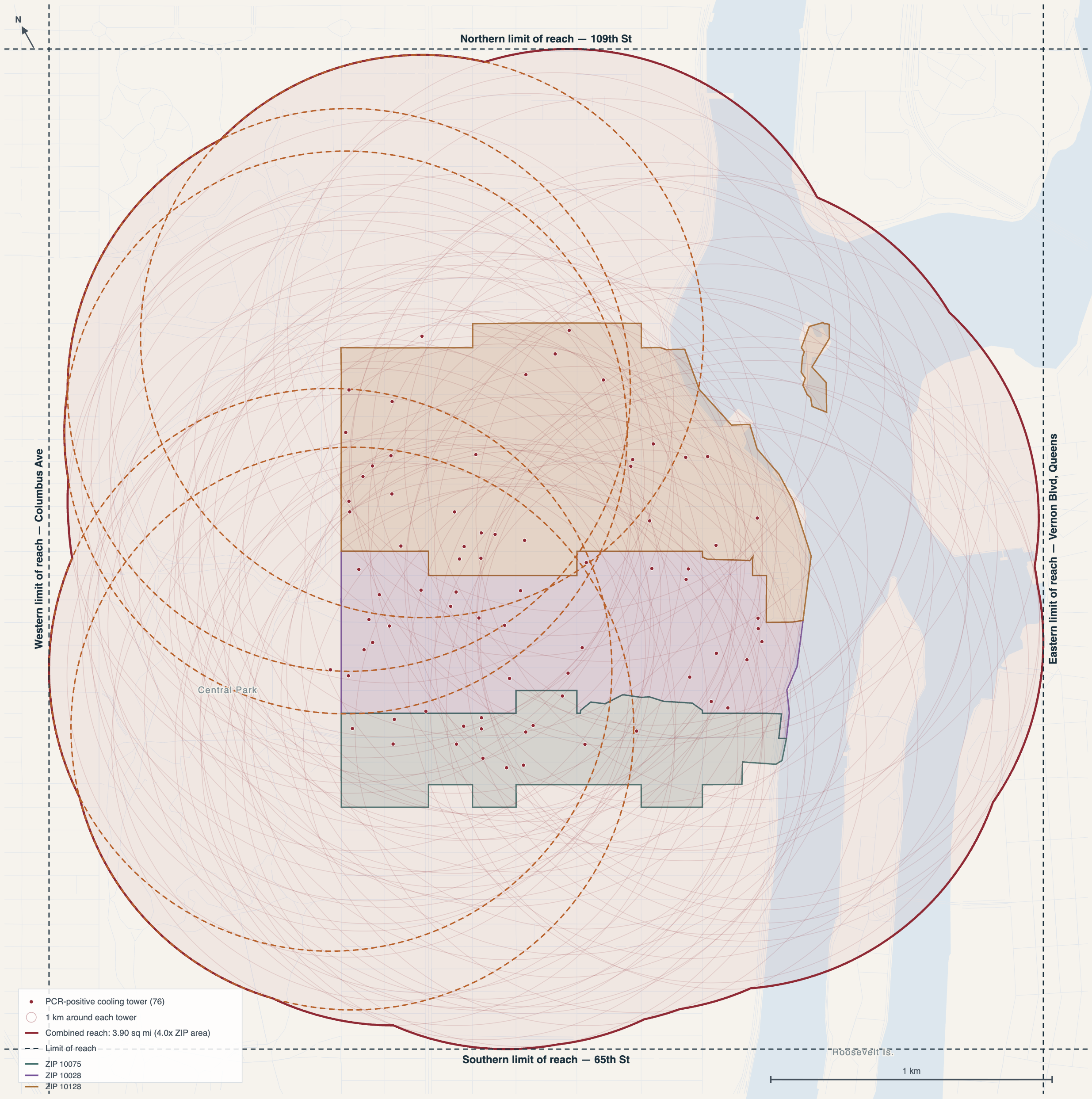
What you see is a plausible spread pattern extending all the way west to Columbus Avenue, north to 109th Street, east to Vernon Boulevard and in Queens, and south to 65th Street.
Remember: a plausible spread pattern is not the same as the actual. spread pattern. Many of the PCR-positive cooling towers will turn out not to have been harboring live Legionella. And spread patterns are not the same as confirmed cases of disease having been acquired.
The easiest way to determine whether cases are emerging outside of the identified zip codes?2
DOHMH knows the answer to the question; it could simply provide that answer to the public.
- 1.
DOHMH states that cultures have been taken from all cooling towers and will be processed regardless of the PCR status of the tower. It is expected that a significant fraction of the cooling towers that tested positive on PCR will return cultures showing no live Legionella bacteria.
- 2.
Which would still require an analysis of whether such patients had traveled within the identified zip codes.
Protecting the public from disease information?
DOHMH has stated that Legionnaires’ can be “serious” and “even fatal,” but one peculiar aspect its communications throughout the outbreak — and it has been an unbroken pattern — is the absence of any discussion of post-diagnosis symptoms of Legionnaires’ disease. What can the course of the disease look like? Stout, for example, has previously told Remapping Debate that many patients “end up in the ICU because of the severity and the need for assisted ventilation.” (DOHMH has not gotten back to me with the view of its experts as to the accuracy of this assessment.)
Why doesn’t DOHMH publish, along with the rest of its data, overall information (non- individually identifiable) information about patient condition, ICU status, and ventilator status?
Failing to do so is not outside of the U.S. norm. But, elsewhere, there are health departments not as squeamish. During a 2024 outbreak in Middlesex-London in Ontario, Canada, the health authority put out a press release specifying that, of 30 patients, all of whom had been hospitalized at some point, “nine were admitted to the Intensive Care Unit.”
In the course of a 2003-2004 outbreak, French public-health authorities in the Nord-Pas-de-Calais region regularly reported the ICU census, with hospitalization figures including five cited in this Jan. 12 report,3 and the six cited in this Jan. 15 report.4
During a 2014 outbreak in Portugal, the health authorities issue a joint communication that included a statement that, “At this time, we can confirm that 38 patients remain in a serious condition in receipt of intensive care, of these 23 are currently receiving ventilatory support.”5
DOHMH has suggested two reasons for not making further disclosures. First, its spokesman says that, unlike a disease like measles, people generally take Legionnaires’ seriously. In other words, people don’t need more disclosures. My follow-up question about whether DOHMH was confident that the public was universally well-informed about Legionnaires’ was not responded to.
The other reason for non-disclosure cited by Fowler is that, in the context of a relatively small patient population, DOHMH made the decision to be what Fowler characterized as respectful of patient privacy. I reemphasized that I was looking for overall ICU and ventilator counts among any confirmed cases (72 as of this writing) or among those remaining hospitalized (9 as of this writing), and no further response was forthcoming.
I reached out to three experts on medical ethics: Nancy Kass, a professor of bioethics and public health at Johns Hopkins who is deputy director for public health in an institute of bioethics; Glenn Cohen a law professor and the faculty director of a center for health law policy, biotechnology, and bioethics at Harvard; and Lawrence Gostin, a law professor and faculty director of an institute for national and global health law.
Kass suggested that “people can sometimes be identifiable in ways that you might not expect,” but that additional details such as condition as ICU status could be important to help the public understand the potential seriousness of Legionnaires’ — “sharing that information … can underscore that reality.”
Gostin said: “I don’t see any privacy justification for releasing aggregate non identifiable data, unless those data could be linked to actual patients. There is a strong public interest in providing information to the press and the public. It’s needed to warn New Yorkers of dangers or to reassure them. Data is also important for public accountability.”
And Cohen responded: “From the information you provided me it doesn’t sound like there is a real individual patient privacy concern that justifies not sharing this information. They have not provided any reason to think a mere patient count would render identifiable any patient, though I would be open to reevaluating that initial assessment if they articulate their reasoning. In my experience vague articulations of ‘privacy’ are sometimes used as pretextual reasons to avoid sharing public health information.”
Cohen added that a lesson of the Covid experience is that “public health is best served when government can share as much accurate information as possible as quickly as possible.”
DOHMH has not articulated how, in an three-zip-code area in which more than 100,000 people live (and tens of thousand more travel to each day), individual patient privacy would be breached by a statement like, “So far in the outbreak, X patients have had to be treated in the ICU, and Y patients have had to be put on ventilators.”
- 3.
DeepL translated “La légionellose dans le Lensois a donc touché, à ce jour, 69 personnes. 9 sont décédées, 20 sont hospitalisées, dont 5 en réanimation et 30 ont regagné leur domicile” as “To date, the Legionnaires’ disease outbreak in the Lens area has affected 69 people. Nine have died, 20 are hospitalized—including five in intensive care—and 40 have returned home.”
- 4.
DeepL translated “La légionellose dans le Lensois a donc touché, à ce jour, 71 personnes. 9 sont décédées, 22 sont hospitalisées, dont 6 en réanimation et 40 ont regagné leur domicile” as “To date, the Legionnaires’ disease outbreak in the Lens area has affected 71 people. Nine have died, 22 are hospitalized—including six in intensive care—and 40 have returned home.”
- 5.
See page 4.
How rare? Where’s an updated surveillance report?
At a July 13 virtual town hall held by DOHMH, Department officials characterizes Legionnaires’ as “very rare.” Since a communicable disease report covering the period from 2015 through 2024 shows an annual range from a low of 269 (2016) to a high of 656 (2018), I wanted to find out why New Yorkers should understand this case range as “very rare.” I also wanted to find out more about sporadic cases stemming from cooling towers.
DOHMH’s Legionnaires’ 2019-2022 surveillance report is very helpful because it has information on sources. In each year there were between 205 and 291 cases in the combined “neither health care nor travel categories” and “unknown categories. Is it possible for a cooling tower to yield only one or two infections within the requisite spatial window and within the requisite geography (so that the cases exist but are not identified as a “community cluster”). The DOHMH spokesperson said this was a questions for the Department’s experts, but no information was forthcoming.
Last, I asked whether there is a newer version of the surveillance report (or an equivalent). I was not able to find any such document and I have not got an answer on that question, either.
This article was updated on July 19 (post-publication) to account for a third death reported by DOHMH in the evening.